Showing posts with label terlato. Show all posts

Thursday, June 11, 2020

The Botanical Drink of the Summer made with L’Apertivo Nonino by Philip S. Kampe


Since the pandemic has taken over our daily lives, cooking and drinking wine and spirits, daily, has become a ritual in our household.

I have been the sole cook in our family for the past 26 plus years. Since work is a thing of the past, my wife has started to join me in the kitchen. She has been using cher Caprese mother’s recipes to create several main courses. And has found a knack for creating desserts.

Having been in the candy and ice cream (Fabulous Phil’s Gourmet Ice Cream) business for several years, my yearning for sweets diminished because I over consumed during those years. My appetite for sweets had changed since my wife, Maria started making pastries.

My position of house sommelier has an added change, I am now the house bartender. What that means is, I can make up drinks and the two of us can enjoy the fruit of the labor. Negroni style drinks have been big hits, as we both love vermouth and Campari.

Maria’s mother, Anna, was known for her devotion to sweet vermouth and martinis at dinner time. We, now, call that ‘Happy Hour.’

One of the drinks that has taken our ‘Happy Hour’ by fancy is a cocktail made with botanicals from the famous Italian Nonino sisters (Elizabetta, Antonella & Cristina) 1940 recipe from their grandmother, Silvea Milocco.

Their grandmother was a pioneer in the spirits world, as she was the first woman in Italy to produce Grappa. Her recipe for the apertivo was lost during the war and recently surfaced. The sisters followed the recipe which includes sixteen vegan friendly, all natural botanicals. The infusion of berries, herbs, roots and flowers helped create a fruity, somewhat bitter, citrus product, full of white peach, lemon, rhubarb and gentian root, appropriately named L’Apertivo Nonino.

Distillation took place in a copper steam still with the head and tail removed. In layman’s terms, it was a modified copper still.

The result is a relatively new (2019 release) botanical apertivo called L’Apertivo Nonino.

As you can see in the photos, the bottle is quite elegant. The design includes the three sisters incorporated into a botanical design.

On the backside of the bottle is a recipe for a cocktail, which has become our favorite drink of the pandemic. It is simple to make and doesn’t seem to have a name. So, we call it L’Apertivo Nonino.

Ingredients:
2 parts L’Apertivo Nonino
1 part Sparkling wine
A splash of lemon juice

Preparation:
Add ice cubes to a bourbon glass, mix the ingredients above in the glass and add a lemon wheel to the glass and serve.

Its a hit in our home, thanks to this lost recipe of 80 years ago.

Philip S. Kampe
Philip.kampe@thewinehub.com


Friday, January 3, 2020

Dueling Pistols Tense Wine Blend from Terlato by Philip S. Kampe


                             Dueling Pistols Red Wine Blends Shoots to Win the Market


‘Dueling Pistols’ red blends may be considered both a disruptive and innovative wine at the same time. The wine label is tension-packed, opening a story line the consumer can be part of. We are talking about you, Gen X., the consumer. You are the generation that wants to understand the products you consume, both visually and in this case, internally.

Tension in the bottle is when the two blends in each bottle duel for superiority. Both blends are bold, but, in different ways. The Paso Robles is half Cabernet Sauvignon and half Petit Sirah, while the Dry Creek is half Zinfandel and half Syrah. Get the idea?  Competing varietals fighting for dominance only make good bed partners who work together in the end.

Somehow, the Dueling Pistols (the two varietals) emerge as one.

Its not magic, but, intrigue, on the winemakers part. Both wines rested in French Oak (American & Hungarian) for fifteen (15) to eighteen (18) months. During that period, interplay between the varietals peaked, having end products blend into one.

What I thought about the wines:

Dueling Pistols Dry Creek Red Blend 2016   (50% Zinfandel  50% Syrah)   $49.99
Bright cherry aromas, lively acidity, lots of spice, dense, 50 year old Zinfandel vines and twelve (12) Syrah vines planted in clay soils, velvety in the mid-palate.

Dueling Pistols Paso Robles Red Blend 2016    (50% Cabernet Sauvignon & 50% Petite Sirah)   $49.99
This is certainly a tough wine to master. Rarely planted Petite Sirah, with its huge, intense tannins are hard to balance. Bring on a Paso Robles Cabernet Sauvignon and you have met your match. The result is a jammy, dense, soft edged wine with under the ocean tannins that linger throughout the night. Sweet plum and black cherry dominate the palate.

Philip S. Kampe


Tuesday, May 14, 2019

'Nino Franco' Celebrates 100 Years of Prosecco: 1919-2019 by Philip S. Kampe


                                  Primo Franco, The Architect of Modern Day Prosecco


 Prosecco may be ‘the newest sparkling wine’ to dominate the crowded bubbly market, but is Prosecco a new sparkling wine or has it been around and has been recently re-discovered?

That was the question I posed to Primo Franco, the voice and ambassador for his family’s
’Nino Franco’ winery from Veneto. They are a major Prosecco producer thanks to Antonio Franco who founded the winery in Valdobbiadene (Italy) in 1919, a mere ‘hundred years’ ago.

Antonio was a first generation winemaker who passed the reigns to son Nino, who, in time, passed it on to his son, Primo, who I dined with. Primo earned his diploma from the prestigious Conegliano Veneto, school of enology, and has guided the winery ever since.

Primo, as one can tell upon meeting him, is overly organized and philosophical about Cantine Franco. He elaborated that his mission was to make the best Prosecco in the marketplace.

To obtain his goal, thirty years ago, Primo, the enologist, experimented with planting techniques. He concluded that he favored old clones.

Glera, at least 85%, is the main grape variety used to produce Prosecco. Up to 15% of Pinot Bianco, Bianchetta, Verdiso, Perera, Chardonnay, Pinot Nero and Pinot Grigio are allowed to be mixed with the Glera varietal. Glera was originally known as Prosecco, but, was changed to stop confusion regarding the town of Posecco.

Glera is an indigenous varietal. The grape grows in large clusters and is very thin-skinned. It is a cool climate grape that grows best on hillsides. On a trip to the area, the steepness of the vineyards astounded me. Each hillside had its own microclimate. The end result is in the grapes. Consistent acid paired with low alcohol are the make-up from the hilly strips of land in the province of Treviso. The Primo Franco plantings lie somewhere in-between the major towns of Valdobbiadene and Conegliano. The region gained DOCG status in 2009 and represents the top tier of Prosecco production.

The Prosecco’s that I sampled from Nino Franco lived up to all expectations. Primo has been called the architect of the worldwide Prosecco explosion and his wines are all ‘All-Star’ status. By dedicating his life to Prosecco, Primo has changed the world’s taste buds.

He has introduced DOCG Prosecco to the world and should go down in history as the architect of modern-day Prosecco.

The four ‘Nino Franco’ Proseccos I recommend trying yo start your journey into Primo Franco’s World are:

Primo Franco Valdobbiadene Prosecco Superiore DOCG 2017 ($37)
Classified as dry, I found this to be somewhat sweet, although it contains only 30-32 G/L sugar. The Charmat Method is used. The final product is elegant, full of green apple, tangerine, nutella qualities and walnut dust.

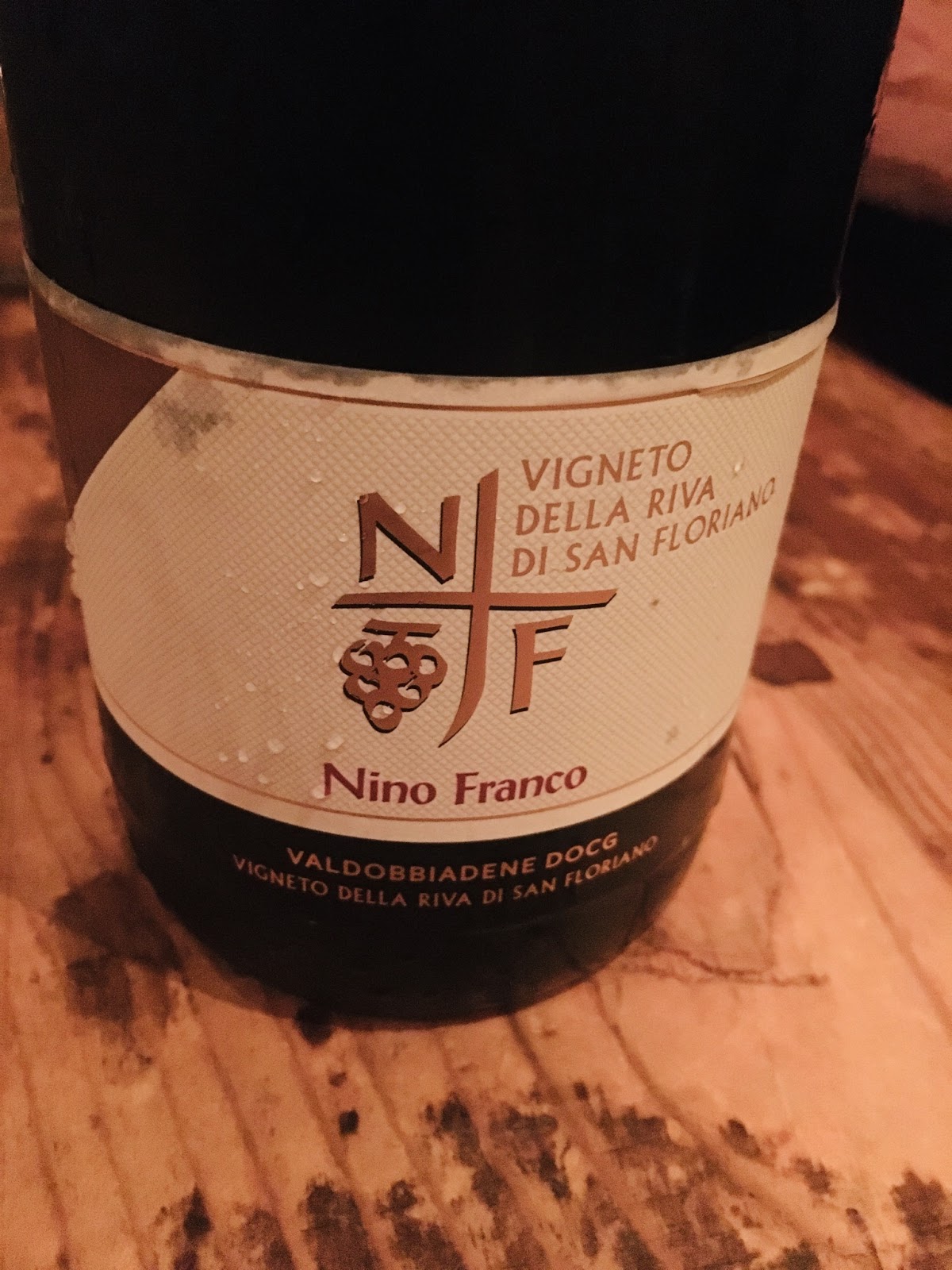
Vigneto Della Riva Di San Floriano Valdobbiadene Prosecco Superiore DOCG 2017 ($37)
This was a wonderful Brut that was persistent on the palate and quite intense. It certainly was a dignified Prosecco that could and should be drunk on its own, if one chooses. Superior by all standards.

Rustico NV ($24)
A fruity,lively Charmat Method Brut that works perfectly as an aperitif or as an after dinner sparkler. It’s a perfect hors d’oeuvre wine made with 100% Glera grapes.

Faive Rose Brut 2017 ($29)
A wonderful twist that sets Nino Franco apart from other vineyards in the region is Primo’s grape selection. Made from 80% Merlot and 20% Cabernet Franc, this bubble-filled Rose has all of the qualities that should make this bubbly the life of a party-think summer.

If you have further interest in learning about Primo Franco and Nino Franco wines, visit their website at: www.ninofranco.it 
The website is in both Italian and English.
It is a wonderful resource that acquaints you with Prosecco and how the Franco family contributed to Prosecco’s growth.


Thursday, March 23, 2017

Why Mathilde Chapoutier's 2016 Grand Ferrage Rose is the Best? by Philip S. Kampe


                                                      2016 Grand Ferrage  

With Rose season upon us, yes and all of the Roses on the market, it is often hard to find the right Rose that can be your ‘go to Rose’ this summer.

My goal was to find the quintessential Rose.

After attending a handful of Rose Portfolio tastings and samplings, with over three hundred Roses offered, I knew the decision would be difficult, if not impossible. After narrowing the choices to a handful, I began to analyze each bottle and time after time, the Roses from Provence were in the running, as well as a few from, yes, Austria.

Roses from Provence started the trend, which has grown by double digits each quarter for the past several years.

 Today, you can easily find Rose sections filling space at your favorite wine shop-something unheard of years ago.

Roses are the late bloomers, leading the growth charts in the United States.

When I look for in a Rose is diversity. I don’t think of a Rose the same way that I think of other wines. Complexity and ageing factors do not matter.

What matters, as I mentioned before is diversity. What is diversity? In my case, diversity is one wine that can accommodate a complete evening of entertaining, from aperitif to dessert.

The Rose that I found that can accommodate nearly all foods is from Provence’s, Mathilde Chapoutier.

The wine is: Grand Ferrage Cotes de Provence Rose 2016 (under $20)

Mathilde is not a newcomer to the wine world. Her father and mentor is the notorious Michel Chapoutier (look him up).

Mathilde is a new generation winemaker. She does it all-designs the label-makes and markets the wine-and has the spirit of the ‘Flower Power Generation.’

She runs the show.

The 2016 Grand Ferrage is light, fruity and has an inner soul that coats and stays on your palate to tackle all types of food. At a recent lunch, the 2016 Grand Ferrage was put to the test and won-hands down-as a soup to nuts wine-one that was poured with each of the fifteen courses, including several that were gifts from the chef.

The Grand Ferrage is the diverse type of wine that can stand up to all dishes, whether creamy and sweet or spicy and hot.

My wine guidelines were taught to me by my parents. They would try the one bottle approach. Their only true success was Champagne.

With that upbringing and kitchen skills, I have looked far and wide for the new Champagne in my life.

And thanks to Mathilde Chapoutier, I have found it.


                                 The 2016 Grand Ferrage is the King of the Boardroom

Philip S. Kampe
philip.kampe@thewinehub.com

40 Years of Winemaking at Russian River Valleys Sonoma-Cutrer by Philip S. Kampe

 Innovation in Winemaking at Sonoma-Cutrer began forty years ago. The focus has always been innovation for this Russian River Valley winery....