Showing posts with label Consorzio de tutelage valpolicella. Show all posts

Tuesday, August 7, 2018

Amarone Loves Corvina by Philip S. Kampe


                                                   Amarone Loves Corvina

Why is Amarone della Valpolicella so special?
First of all, it’s sort of scarce. And it is difficult to make.

The Corvina and Corvinone grapes make up the majority of the blend used in making Amarone. Add Molinara for acidity and Rondinella for soft tannins. Aromas vary by grape variety-from tobacco to black pepper.

Together, these varietals, plus appropriate aging, by law, four years for Reserva and two years for Valpolicella DOCG and Recioto della Valpolicella DOCG, are some of the reasons why these wines are like none others.||

Verona is my favorite city in the whole world. Not sure why, but, that’s reality. Maybe it’s the pink marble or maybe it’s the wine. Or  maybe its Restaurant Greppia, my personal favorite. Who knows?

When you travel in pursuit of Valpolicella, there are three sub-regions in Veneto that accommodate the wine lover. Est (means east) and contains (4 ) four valleys and seven (7) destinations. Valpantena has three (3) designations and Classico has six (6) designations in three (3) valleys.

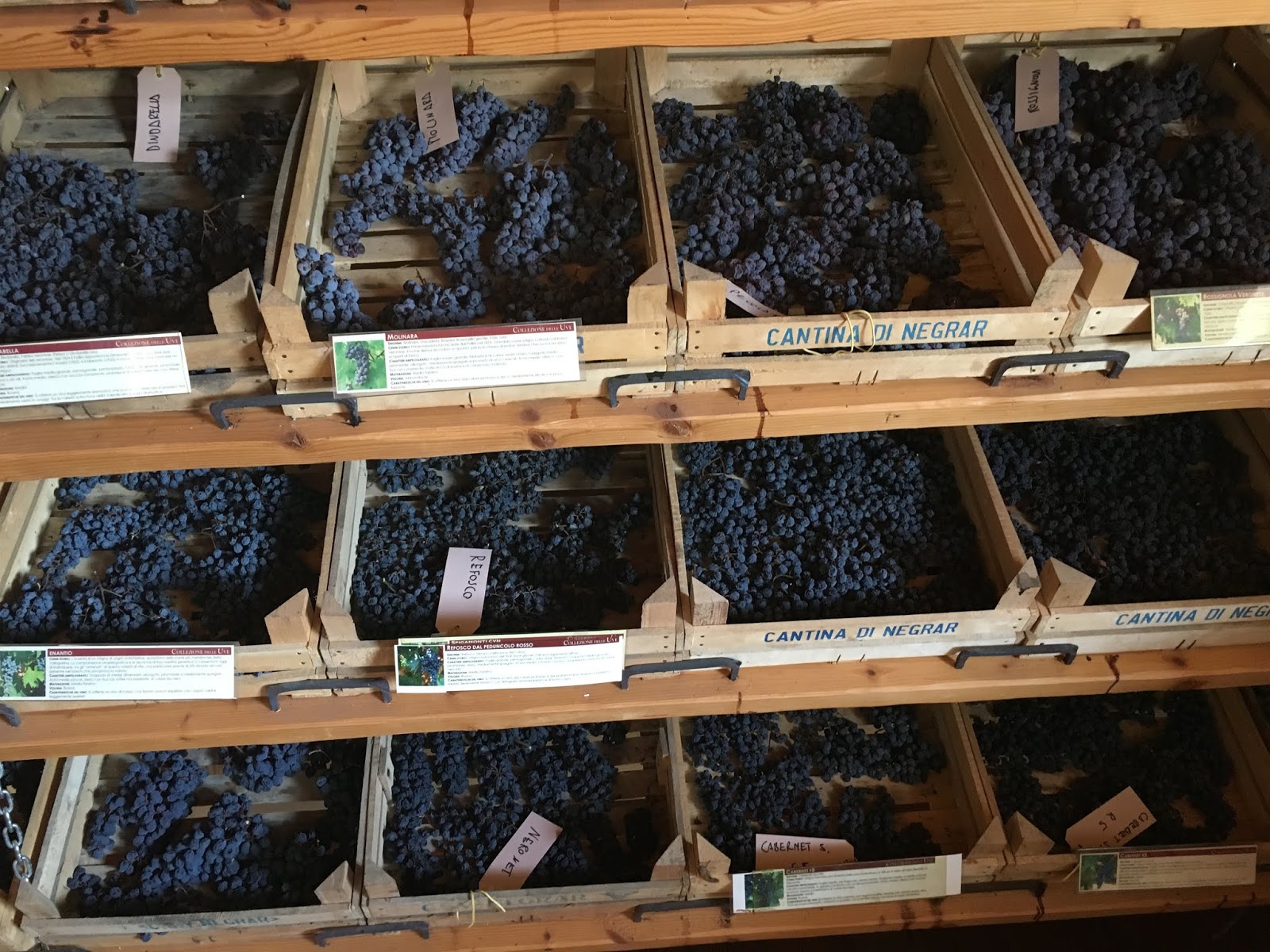
Having visited the region on several occasions, but, never during the harvest, I have learned that the grapes are hand-harvested and laid out on straw mats for a minimum of four months to turn into the prime grape (s) for Amarone della Valpolicella DOCG. Then, the grapes are pressed. Fermentation can last up to two months, thanks to low temperature fermentation.  The wine is then transferred to chestnut or oak barrels to age, following the laws of the region.

As I mentioned earlier, Amarone is scarce. There are only 12,000 acres that satisfy the region for Amarone. That is where the Corvina and Corvinone grapes thrive.

Interviewing several winemakers, the Corvina grape is their favorite varietal. It may be because the other grape they love is Corvinone. Unfortunately, the grape is rare, making Corvina their first choice.

The rule of thumb with Amarone is quite simple.
‘The older, the better.’

At a recent Anteprima Amarone tasting, I sampled a 1950 Amarone that was as fresh and acidic as a wine of that age could be. The true flavor profile of Amarone existed, sixty-eight (68) years later-fig, sweet chocolate and vanilla bean.

Amarone goes through a different process of aging versus other wines. The final palate flavor resonates with me.

Few wines are made the same way-grapes are dried for four months, then the grapes are slowly pressed and then fermented for sixty (60) days.

These are just a few reasons why I believe Valpolicella is like no other wine.

Philip S. Kampe


Monday, July 30, 2018

Valpolicella, The Whole Story by Philip S.Kampe


                              The map of Italy highlighting the Valpolicella region
                   Besides Corvina, Valpolicella is home to many other varietals
                                                          Drying of the grapes

            
Its always uplifting to receive so many emails about my many Valpolicella articles.

Yes, my father gave me my first sip of Valpolicella when I was under ten years old. Yes, my wife, from Italian roots has family members who drink a glass or two of Valpolicella daily. They say it is for health reasons. And, yes, I always try to promote Valpolicella to others at dinners or parties at our house or bring a bottle as a gift to those with or without wine knowledge.

As a true novice Valpolicella wine lover, I am happy to share with you the facts I know about this wine and realize that there are numerous Valpolicella Ambassadors who know so much more then I do and live the life of true devotion to ‘everything Valpolicella.’

Where is Valpolicella’s home:
The province of Verona, east of Lake Garda.

Climate:
Mild to cool Continental climate

Valpolicella styles:
Valpolicella Classico, Valpolicella Superiore, Recioto, Amarone

When did Valpolicella receive DOC status?
1968

Serve Valpolicella:
Slightly chilled

The Valpolicella Story:
Historical documents suggest that in the 5th century, Cassiodorus, minister of Theodoric the Great, suggested to the barbaric king of the Osthrogots that he should try a sweet wine from one of the territories of his kingdom.

The wine he suggested was from near Verona, which was the capital of the Italian territories that Theodoric the Great, his King, ruled.

Cassiodorus went on to explain that the wine comes in both red and white varieties and was made with the Corvina grape, which is left to dry (four months) until winter before being crushed.

Fast forward 1600 years and similar wines from the Valpolicella region are made using the same process and the same, Corvina varietal. The grapes are dried, many for four months, after harvest and turned into the Recioto style of Valpolicella.

The grape drying process is actually quite complex. The process activates more then four-hundred (400) genes that control the metabolism of the grapes, which activates secondary flavors and classic aromas of both Recioto and Amarone. Corvina may be the only grape that remains active and functioning during the drying process. Other grapes remain inactive. While being active when drying, the Corvina grape develops the classic aromatic profile of Amarone.

If the Corvina grapes grow in different appellations throughout the world, the grape would take on different characteristics and would not remain active when drying. That tells us that the perfect conditions for the Corvina varietal exist only in the Valpolicella region. It has been that way, as I illustrated, for thousands of years. This is why Valpolicella wines excite my palate..

Where did the name come from?
The name, Valpolicella, comes from Latin, Vallis Polis Cellas, which translated, means, ‘Valley of the Many Cellars.’

Are there other indigenous grape varieties grown in Valpolicella?
Yes, besides Corvina, many varieties exist. Molinara, Oseletto, Rondinella, Pelara, Garganega and Croatina, to name a few.

What you need to know about Valpolicella DOC:
Valpolicella is made using fresh grapes. Recioto and Amarone are made using dried grapes. The three most popular grapes in the Valpolicella wines include, Corvina (which you should know about), Molinara and Rondinella.

How do I read the labels?
If the label has Valpolicella Classico on it, the wine was produced in the historical wine producing area of Valpolicella. If the label just has Valpolicella, the wine comes from the extended Valpolicella wine producing region. Valpolicella grapes are always picked after the grapes for Recioto and Amarone. The quality may be the same, but, those grapes that are picked first are purposely picked out for their drying potential. Most grapes can’t withstand the four month drying period.

What should you expect when tasting Valpolicella?
Valpolicella is a medium-bodied, crisp, acidic wine with a secondary fruitiness, typical of the Corvina grape, which normally accounts for 70% of the grape blend. Its deep ruby color and soft palate appeal make for a terrific food wine. As I mentioned earlier, chill your bottles for 15-20 minutes before serving.

Are Valpolicella wines expensive?
No, quite the opposite.
Valpolicella wines are inexpensive and very affordable.


Philip S. Kampe


Thursday, March 1, 2018

The Valpolicella World As Seen by Olga Bussinello by Philip S. Kampe

Imagine the responsibilities of being the director of the Consortium for the Tutelage of Valpolicella Wines. Your responsibility is to be the voice of a region that has 19 municipalities, 114 companies, 2500 acres and produces 60 million bottles of wine.
                                                             Olga Bussinello

To be the voice of the winemakers, bottlers and producers of the region, only a dedicated person can take on the job effectively and live the life of Valpolicella as a lifestyle, day in and day out.

The person that lives and dreams the Valpolicella lifestyle is and has been for many years is Olga Bussinello, a woman whose blood is made up of the classic Valpolicella grape blend.

Her dedication to the Consorzio is unmatched.

Through the years I have seen the evolution of Olga Bussinello.

At my most recent encounter, her leadership and knowledge took center stage at the “Sustainable Winegrowing Summit 2018” in Verona, as well as her guidance with the release of the 2014 vintage at Anteprima Amarone.

Olga stressed the mantra, “RRR-Reduce, Respect, Retrench” in regard to the environmental sustainability and wealth of the land at the sustainable conference. She said that sustainability is the future communication for our wine and to communicate our DOP (Protected Designation of Origin) is another challenge for her and the 2347 grape growers, 7 cooperatives and 213 wine companies in Valpolicella,

Sales of Valpolicella wines are broken down in this order;
Valpolicella Ripasso DOC 45%
Valpolicella DOC 32%
Amarone DOC 22%

Olga elaborated on the 2017 harvest.
It was a good harvest-no hail, but, a lack of rain in both the spring and summer, which reduces the quantity of the grapes. Fortunately, analysis of the grapes is very positive. The 2017 batch has more sugar in the grape (higher alcohol) and more reservations, polyphenols and glycerin.

The wines that comprise Valpolicella generally have soft tannins, are well balanced and are very round on the palate. The majority of grapes used to produce Valpolicella are always an indigenous blend and are grown in three regions and thirteen valleys, each with a unique microclimate and soils ranging from limestone to volcanic.

Sounds like a lot going on , to you and me, in this region., but, with the leadership of Olga Bussinello there is nothing to worry about.

Look for the newest release, the 2014 Amarone DOC in your local wine shop, as well as the Valpolicella Ripasso DOC and the Valpolicella DOC.

After sampling any of these fine wines, you will understand why Olga Bussinello loves her job.

Philip S. Kampe
philipkampe@thewinehub.com

40 Years of Winemaking at Russian River Valleys Sonoma-Cutrer by Philip S. Kampe

 Innovation in Winemaking at Sonoma-Cutrer began forty years ago. The focus has always been innovation for this Russian River Valley winery....