Showing posts with label Valpolicella. Show all posts

Tuesday, August 7, 2018

Amarone Loves Corvina by Philip S. Kampe


                                                   Amarone Loves Corvina

Why is Amarone della Valpolicella so special?
First of all, it’s sort of scarce. And it is difficult to make.

The Corvina and Corvinone grapes make up the majority of the blend used in making Amarone. Add Molinara for acidity and Rondinella for soft tannins. Aromas vary by grape variety-from tobacco to black pepper.

Together, these varietals, plus appropriate aging, by law, four years for Reserva and two years for Valpolicella DOCG and Recioto della Valpolicella DOCG, are some of the reasons why these wines are like none others.||

Verona is my favorite city in the whole world. Not sure why, but, that’s reality. Maybe it’s the pink marble or maybe it’s the wine. Or  maybe its Restaurant Greppia, my personal favorite. Who knows?

When you travel in pursuit of Valpolicella, there are three sub-regions in Veneto that accommodate the wine lover. Est (means east) and contains (4 ) four valleys and seven (7) destinations. Valpantena has three (3) designations and Classico has six (6) designations in three (3) valleys.

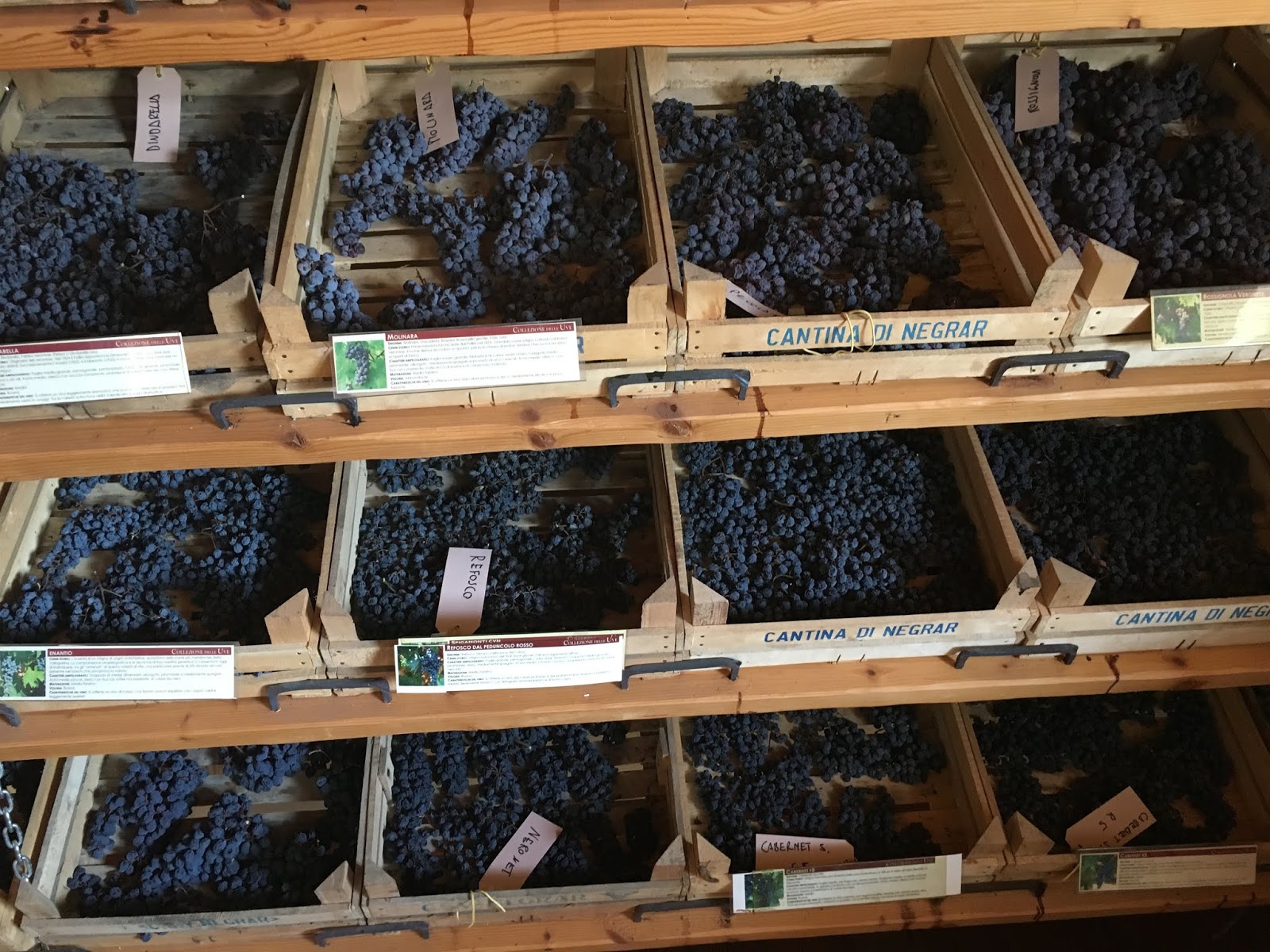
Having visited the region on several occasions, but, never during the harvest, I have learned that the grapes are hand-harvested and laid out on straw mats for a minimum of four months to turn into the prime grape (s) for Amarone della Valpolicella DOCG. Then, the grapes are pressed. Fermentation can last up to two months, thanks to low temperature fermentation.  The wine is then transferred to chestnut or oak barrels to age, following the laws of the region.

As I mentioned earlier, Amarone is scarce. There are only 12,000 acres that satisfy the region for Amarone. That is where the Corvina and Corvinone grapes thrive.

Interviewing several winemakers, the Corvina grape is their favorite varietal. It may be because the other grape they love is Corvinone. Unfortunately, the grape is rare, making Corvina their first choice.

The rule of thumb with Amarone is quite simple.
‘The older, the better.’

At a recent Anteprima Amarone tasting, I sampled a 1950 Amarone that was as fresh and acidic as a wine of that age could be. The true flavor profile of Amarone existed, sixty-eight (68) years later-fig, sweet chocolate and vanilla bean.

Amarone goes through a different process of aging versus other wines. The final palate flavor resonates with me.

Few wines are made the same way-grapes are dried for four months, then the grapes are slowly pressed and then fermented for sixty (60) days.

These are just a few reasons why I believe Valpolicella is like no other wine.

Philip S. Kampe


Monday, July 30, 2018

Valpolicella, The Whole Story by Philip S.Kampe


                              The map of Italy highlighting the Valpolicella region
                   Besides Corvina, Valpolicella is home to many other varietals
                                                          Drying of the grapes

            
Its always uplifting to receive so many emails about my many Valpolicella articles.

Yes, my father gave me my first sip of Valpolicella when I was under ten years old. Yes, my wife, from Italian roots has family members who drink a glass or two of Valpolicella daily. They say it is for health reasons. And, yes, I always try to promote Valpolicella to others at dinners or parties at our house or bring a bottle as a gift to those with or without wine knowledge.

As a true novice Valpolicella wine lover, I am happy to share with you the facts I know about this wine and realize that there are numerous Valpolicella Ambassadors who know so much more then I do and live the life of true devotion to ‘everything Valpolicella.’

Where is Valpolicella’s home:
The province of Verona, east of Lake Garda.

Climate:
Mild to cool Continental climate

Valpolicella styles:
Valpolicella Classico, Valpolicella Superiore, Recioto, Amarone

When did Valpolicella receive DOC status?
1968

Serve Valpolicella:
Slightly chilled

The Valpolicella Story:
Historical documents suggest that in the 5th century, Cassiodorus, minister of Theodoric the Great, suggested to the barbaric king of the Osthrogots that he should try a sweet wine from one of the territories of his kingdom.

The wine he suggested was from near Verona, which was the capital of the Italian territories that Theodoric the Great, his King, ruled.

Cassiodorus went on to explain that the wine comes in both red and white varieties and was made with the Corvina grape, which is left to dry (four months) until winter before being crushed.

Fast forward 1600 years and similar wines from the Valpolicella region are made using the same process and the same, Corvina varietal. The grapes are dried, many for four months, after harvest and turned into the Recioto style of Valpolicella.

The grape drying process is actually quite complex. The process activates more then four-hundred (400) genes that control the metabolism of the grapes, which activates secondary flavors and classic aromas of both Recioto and Amarone. Corvina may be the only grape that remains active and functioning during the drying process. Other grapes remain inactive. While being active when drying, the Corvina grape develops the classic aromatic profile of Amarone.

If the Corvina grapes grow in different appellations throughout the world, the grape would take on different characteristics and would not remain active when drying. That tells us that the perfect conditions for the Corvina varietal exist only in the Valpolicella region. It has been that way, as I illustrated, for thousands of years. This is why Valpolicella wines excite my palate..

Where did the name come from?
The name, Valpolicella, comes from Latin, Vallis Polis Cellas, which translated, means, ‘Valley of the Many Cellars.’

Are there other indigenous grape varieties grown in Valpolicella?
Yes, besides Corvina, many varieties exist. Molinara, Oseletto, Rondinella, Pelara, Garganega and Croatina, to name a few.

What you need to know about Valpolicella DOC:
Valpolicella is made using fresh grapes. Recioto and Amarone are made using dried grapes. The three most popular grapes in the Valpolicella wines include, Corvina (which you should know about), Molinara and Rondinella.

How do I read the labels?
If the label has Valpolicella Classico on it, the wine was produced in the historical wine producing area of Valpolicella. If the label just has Valpolicella, the wine comes from the extended Valpolicella wine producing region. Valpolicella grapes are always picked after the grapes for Recioto and Amarone. The quality may be the same, but, those grapes that are picked first are purposely picked out for their drying potential. Most grapes can’t withstand the four month drying period.

What should you expect when tasting Valpolicella?
Valpolicella is a medium-bodied, crisp, acidic wine with a secondary fruitiness, typical of the Corvina grape, which normally accounts for 70% of the grape blend. Its deep ruby color and soft palate appeal make for a terrific food wine. As I mentioned earlier, chill your bottles for 15-20 minutes before serving.

Are Valpolicella wines expensive?
No, quite the opposite.
Valpolicella wines are inexpensive and very affordable.


Philip S. Kampe


Friday, July 20, 2018

Valpolicella Is A Soft, Fruity Summer Wine by Philip S. Kampe


                                           Valpolicella DOC Celebrates ’50 Years’

During the summer, many of us tend to drink lighter wines-Rose, Prosecco and New Zealand Sauvignon Blancs.

So do I, to a point.

When that point arrives, my psyche tells me, quite loudly, ‘Where is the Valpolicella?’
Maybe its in my DNA-and it could be. In one of my articles I related to my readers that my father, a man with a curious palate, was a big fan of Valpolicella. Nearly every evening he would have a glass of Valpolicella before bedtime. It was his brandy.When company came over and my parents entertained, my father was most proud to open a couple bottles of Valpolicella and discuss the flavors and vintages with their guests. Needless to say, I sampled many vintages during the years and was so pleased to take part in a vertical tasting in Verona, hosted by the Consorzio Tutela Vini Valpolicella/ I’m sure that many of the wines I sampled were the same as my father poured.

2018 is the 50th Anniversary of Valpolicella receiving its Denomiazione di Origine Controllata (DOC) cerification. Did you know that Valpolicella ranks just after Chianti in total Italian DOC production. The reason is that the vinicultural zone of the province of Verona, east of Lake Garda, in Veneto, is an agricultural powerhouse.

The hilly, fertile land is home to endless wine production.

Three grape varieties are the core of Valpolicella:


Molinara, Rondinella and Corvina Veronese. Many wine variations are produced from these grapes. All are my favorites, which include Valpolicella Classico, Valpolicella Superiore, Amarone and a Recioto dessert wine.

The fertile land in Veneto was the home of the ancient Greeks, who coined the name, Valpolicella, in the 12th century, which loosely translated means, ‘Valley of Cellars.’
With over 60 million bottles produced a year and 75% of the bottles exported, Valpocella remains a sought after wine commodity. The three categories of Valpolicella, sales wise, break down to: 45% Ripasso DOC, 32% Valpolicella ROC and 22% Amarone DOCG.

Authenticity has popped up regarding European wines, mostly due to several issues concerning Spanish, French and Italian wines. To address the issue, the Corsorzio Tutela Vini Valpolicella has adopted the Reduce, Respect, Retrench (RRR) certification. The RRR certifies ‘ethical vineyards.’ What that means is that the vineyards receive certification after five years of work practicing sustainable vine growing and wine producing. According to Olga Bussinello, director of the Valpolicella Consorzio, ‘The RRR certification was a necessary change to foster its spread even more and to reward the virtuous viniculturalists who have followed the process in its pilot phase. This is the first certification of an area with an appellation ‘startup’ in Italy, shared and achieved with the support of local towns, partners in the project, which includes 73% of the vineyard surface area in the Valpolicella appellation Certifying an area entails understanding the landscape and that of the ecosystem, from resource management to safeguarding biodiversity, to the protection of a territory where processional viniculture and urbanization are side-by-side-which is just one chapter in the process.’

A territory as outstanding as Valpolicella understands the demands of the western world, where sustainability comes into play.

Why I love Valpolicella: 97% of the grapes used are indigenous varietals. Sustainability is on the radar. There are 2,347 grape growers, 213 wine companies, 7 cooperatives and 275 bottlers.

Plus, it was my fathers favorite wine.

Happy 50th DOC Anniversary Valpolicella.
We Love You…

Philip S. Kampe


Thursday, March 1, 2018

The Valpolicella World As Seen by Olga Bussinello by Philip S. Kampe

Imagine the responsibilities of being the director of the Consortium for the Tutelage of Valpolicella Wines. Your responsibility is to be the voice of a region that has 19 municipalities, 114 companies, 2500 acres and produces 60 million bottles of wine.
                                                             Olga Bussinello

To be the voice of the winemakers, bottlers and producers of the region, only a dedicated person can take on the job effectively and live the life of Valpolicella as a lifestyle, day in and day out.

The person that lives and dreams the Valpolicella lifestyle is and has been for many years is Olga Bussinello, a woman whose blood is made up of the classic Valpolicella grape blend.

Her dedication to the Consorzio is unmatched.

Through the years I have seen the evolution of Olga Bussinello.

At my most recent encounter, her leadership and knowledge took center stage at the “Sustainable Winegrowing Summit 2018” in Verona, as well as her guidance with the release of the 2014 vintage at Anteprima Amarone.

Olga stressed the mantra, “RRR-Reduce, Respect, Retrench” in regard to the environmental sustainability and wealth of the land at the sustainable conference. She said that sustainability is the future communication for our wine and to communicate our DOP (Protected Designation of Origin) is another challenge for her and the 2347 grape growers, 7 cooperatives and 213 wine companies in Valpolicella,

Sales of Valpolicella wines are broken down in this order;
Valpolicella Ripasso DOC 45%
Valpolicella DOC 32%
Amarone DOC 22%

Olga elaborated on the 2017 harvest.
It was a good harvest-no hail, but, a lack of rain in both the spring and summer, which reduces the quantity of the grapes. Fortunately, analysis of the grapes is very positive. The 2017 batch has more sugar in the grape (higher alcohol) and more reservations, polyphenols and glycerin.

The wines that comprise Valpolicella generally have soft tannins, are well balanced and are very round on the palate. The majority of grapes used to produce Valpolicella are always an indigenous blend and are grown in three regions and thirteen valleys, each with a unique microclimate and soils ranging from limestone to volcanic.

Sounds like a lot going on , to you and me, in this region., but, with the leadership of Olga Bussinello there is nothing to worry about.

Look for the newest release, the 2014 Amarone DOC in your local wine shop, as well as the Valpolicella Ripasso DOC and the Valpolicella DOC.

After sampling any of these fine wines, you will understand why Olga Bussinello loves her job.

Philip S. Kampe
philipkampe@thewinehub.com

Thursday, February 16, 2017

"It's All About Valpolicella and You" and Me at Anteprima Amarone 2017 by Philip S. Kampe


The word, Valpolicella, has a musical ring to it.
The wine, like the word, dances vibrantly and ferociously on your palate.

The Valpolicella region, part of the Veneto, is located near Verona, in northeast Italy. The region comprises eleven valleys, each unique in its own way-from the high heat index of the Marano Valley to the cool breezes from the regions western border, Lake Garda.  

Partly due to the varied terroir and heat index, each of the varietals from the eleven valleys have their own distinctive taste and aroma. Since 2003, global warming has had a direct impact on some, but not all of the varietal growing valleys.

At the 14th Edition of Anteprima Amarone, which was held at the magnificent Palazzo della Gran Guardia, located in the center of breathtaking Verona, Italy, I had the opportunity to sample the 2013 harvest with members of the distinguished international press and selected industry insiders.

Thanks to the generosity of the Consorzio di Tutela Vini Valopicella and the wines from 78 wineries, the blind sampling of 83 barrel and bottle samples proved to be a reward for the palate, due directly to the exceptional quality of the 2013 vintage and the seductive powers of the indigenous grapes used to produce Amarone.

The world agrees with the seductive powers of Amarone.

Upwards of 65% of production is for export, with Germany, United States, Switzerland, United Kingdom, Canada and Sweden leading the way.

The quest for Amarone and other great Veronese wines is the driving force for tourism in the area-a great change from the time honored balcony of Romeo and Juliet fame.

With hundreds of producers and an event that culminates vintage releases, Verona is the place to be.

Add Vinitaly, Italy’s largest annual wine event to the drawing board-and you have the makings of an international wine scene.

With opera events at the Roman amphitheater, locally excavated pink marble that line the pedestrian walkways of Verona and local cuisine paired with Valpolicella, it is obvious that Verona is one of the jewels of the Veneto.

And Amarone is the wine jewel of the region.

Anteprima Amarone 2013 assessed the 2013 vintage as of ‘medium-high quality.’ The Consorzio pointed out that the early growing season was dictated by cool weather with above average rainfall, followed by desert like heat throughout the summer.

It was noted that the 2013 vintage was defined solely by opposite extreme weather conditions.  By combining the initial cool and wet climatic cycle with the extreme hot weather cycle, the ripening of the grapes had dramatic help in creating a special vintage, ripe in sugars, concentrated fruit, elegance and weight. The wines from Negrar Valley were assertive and elegant, while fruit reigned in he Mezzane and Illasi Valleys.

As noted earlier, each valley prospered independently from the climatic divergence in 2013. Valpolicella means ‘valley of many cellars’, whose most famous valley is Negrar, considered the icon in the Valpolicella Classico district.

With climate change as reality, the grapes from the temperate Lake Garda boundaries are less tannic and lighter in color then their counterparts, whose daytime temperature is off the charts.

Due to extreme heat, some producers are planting their vineyards at higher altitudes, while the majority choose to protect their grapes from the sun by adopting the pergola system, whose end result shades the grapes from the sun by way of leaf cover.

Many vineyards have replanted or added varieties that thrive in the sun, specifically the older varietals, Oseleta and Spigamonti. The hope is for subtle tannins and larger aromatics that can only enhance Valpolicella.

The classic Valpolicella blend  includes the most important varietal, Corvina, with the addition of the classic indigenous mix Rondinella, Corvinone and Molinara.

Valpolicella is unique and distinct.

The producers emphasized that there are four distinctive styles of Valpolicella.

Valpolicella Recioto: historical sweet red wine made with dried grapes.  
Valpolicella DOC: fruity, light with subtle tannins
Valpolicella Ripasso DOC: a rich, full-bodied style with lots of bitter cherry
Amarone della Valpolicella DOCG: a high alcohol, rich, spicy, dry wine with a touch of sweetness due to the grapes that have dried for several months before the winemaking process (known as the appasimento method)

The King of Valpolicella is Amarone della Valpolicella. From observation and sampling several hundred bottles, it is obvious that the location dictates the final outcome. As mentioned earlier, each valley has its own ‘tattoo’ on the style of Amarone della Valpolicella that you will drink.

Some winemakers use modern technology to blend Amarone, while others follow tradition and some are somewhere in between the two.

As a new student of Amarone della Valpolicella, I have decided to sample a bottle from each of the eleven valleys and compare one to the other. The variables for each bottle exists-weather-winemaking style-terroir-and grapes used.

Before putting the eleven bottles side by side, I would like to thank the Consorzio di Tutela Vini Valpolicella for opening my eyes to what Valpolicella is and what it is to the world. I saw the passion, care and love that the winemakers have for their beloved Valpolicella and unity for its success.

Anxiously, I await the opportunity to sample the 2014 vintage in January 2018. The winemakers have said that it was a difficult vintage and those who have created Amarone della Valpolicella 2014 may have created a legendary wine.

My favorite wines from the blind tasting of Anteprima Amarone DOCG 2013 were produced by:

Damoli Bruno
Albino Armani
Benedetti Corte Antica
Montezovo-Cottini
Farina
Fidora
Cantina Valpantena Verona
Accordini Igino
Villa Mattielli
Selun di Luigi Marconi
Tinazzi
Vigneti di Ettore

+Note: Some bottles were barrel samples and others were from the bottle

The task of sampling the eighty-three 2013 Amarone della Valpolicella involved several hours. The tasting was set up in two large rooms. At least fifteen sommeliers poured the wines in groups of four. Each participant rated the wines accordingly. Many were barrel samples and were noted by the sommelier upon presentation, others were from the bottle-ready to be released.

In my case, the first 48 wines took close to three hours,when palate fatigue set in. After a two hour break, I returned to sample the final 35 wines.


Philip S. Kampe
philip.kampe@thewinehub.com


Wednesday, April 27, 2016

'Valpolicella receives 'Ethical Vineyard' Certification by Philip S. Kampe


                            Olga Bussinello, Director of the Valpolicella Consortium


                         Christian Marchesini, Chairman of the Valpolicella consortium


We all love Valpolicella.

Since I was a kid, my parents boasted to their friends that their favorite wine was Valpolicella. They drank Valpolicella, not just for special occasions, but, for all occasions. In those days, the choice was somewhat limited versus today's crowded market.

Maybe my parents were on to something. As the years have progressed, the regard for Valpolicella has only grown. When the word, 'Amarone' is mentioned, everyone takes a pause in anticipation of sampling one of the world's most versatile wines.

Since my parents early Valpolicella days, the importance of authenticity for the consumer is important. To address that issue, the Consorzio Tutela Vini Valpolicella has adopted the 'RRR' certification process, a mark on the bottle will distinguish the authenticity of the bottles. 'RRR' stands for the 'Reduce Respect Retrench' project that certifies 'ethical vineyards'. What this means is that the vineyards receive certification after five years of work practicing sustainable vine growing and wine producing.

According to Olga Bussinello, Director of the Valpolicella Consortium, ' The Reduce Respect Retrench (RRR) certification was a necessary change to foster its spread even more and to reward the virtuous viticulturists who have followed the process in its pilot phase. This is the first certification of an area with an appellation 'startup' in Italy, shared and achieved with the support of local towns, partners in the project, which include 73% of the vineyard surface area in the Valpolicella appellation. Certifying an area entails understanding the landscape and that of the ecosystem, from resource management to safeguarding biodiversity, to the protection of a territory where professional viticulture and urbanization are side-by-side--which is just one chapter in the process.'

Christian Marchesini, Chairman of the consortium, adds to the conversation, by pointing out that, ' Consumers all over the western world demand even safer, higher quality and socially sustainable products.  A territory like Valpolicella, which has outstanding viticulture and tends to export 75% of its wines, cannot gloss over features like this, which affect the value of the bottle of wine. We are certain that the market in the United States , the main country we send Valpolicella to, will be happy will be happy to receive bottles with our new sustainable area mark on them.'

Valpolicella Facts:
61.8 Million Bottles Produced
$550 Million in sales
75% of bottles exported
2,347 grape growers
7 cooperatives
213 wine companies
275 bottlers
97% of grapes used are indigenous varieties

The grape breakdow:
70.4% Corvina grape
21.1% Rondinella grape
5.5% other varieties

Worldwide Sales:
45.3% Valpolicella Ripasso DOC
32.3% Valpolicella DOC
21.9% Amarone DOCG


The U.S, Valpolicella Market Sales:
21% Valpolicella Ripasso DOC
14% Valpolicella DOC
10% Amarone DOCG

The Valpolicella region is located north of Verona. It borders Lake Garda to the west and is protected by the Lessini Mountain range to the east and the north. The Verona foothills, known as the eastern Alps, are to the south.

Most of the wines under the Valpolicella DOC are red, using mostly indigenous grapes, as mentioned earlier.
Ripasso is the most popular style.

Developed in the late 1980's and bottles first by Masi,  the Ripasso style emerged. The technique involves using the pomace of leftover grape skins or using partially dried grapes and seeds from the Amarone fermentation and adding the remains during the Ripasso's extended maceration. This tends to boost the remaining yeast by adding better body, higher alcohol levels and smoothing the tannins, glycerine and some phenolic compounds

Much more in-depth information can be found at the Consorzio Per La Tutela website:
www.consorziovalpolicella.it 

Philip S. Kampe
philip.kampe@thewinehub.com 


                                                      Philip S. Kampe

40 Years of Winemaking at Russian River Valleys Sonoma-Cutrer by Philip S. Kampe

 Innovation in Winemaking at Sonoma-Cutrer began forty years ago. The focus has always been innovation for this Russian River Valley winery....