Tuesday, August 21, 2018

Sustainable 'Rose of the Week' from Calabria by Philip S. Kampe


                                                            'Sustainable ' Rose of the Week'
                                                            Ippolito 
Pescanera Rosato 2017


The ‘Rose of the Week’ is made from a rare grape, Greco Nero. Grown on the Ippolito estate in the heart of Calabria’s  (Italy) wine-growing region, in historic Ciro Marina, near the Ionian Sea.

Rolling hills mixed with plains filled with sun, this 950 foot vineyard, founded in 1845 by Vincenzo Ippolito, maintains sustainable farming practices. Besides Greco Nero, the  Ippolito winery grows an array of indigenous grapes, such as Pecorello, Calabrese and Gaglioppo.

The 2017 Pescanera Rose is terroir driven-just like the rest of the portfolio. The wine is fruity without being acidic. Nice structure, with a long, fresh finish.

My belief is that this Rose would make a great aperitif. It is lively and fresh, with a light minerality that comes from wines near the sea.

Salmon pink in color, the aromas seduce you immediately. An intense floral boutique hangs over citrus undertones, followed by a whim of white pepper.

The nose is a crowd pleaser.

The grapes are hand harvested, softly crushed without maceration.

At 13% alcohol and available for under $20, this 2017 Ippolito Pescanera Rose is an IGT worth looking into. It pairs favorably with shelled seafood and soft, fresh cheese. Even raspberries and strawberries melt into this luscious wine.

When was the last time you had a Rose from Calabria?

Philip S. Kampe

Monday, August 13, 2018

'Rose of the Week'-- a Pinot Grigio from Casata Monfort by Philip S. Kampe


Its not difficult to find a Rose with the grapes that you like.

Take the 2017 Casata Monfort Pinot Grigio as an example. Under $15 and considered a ‘good buy,’ this wine from the Dolomotes (northern Italy) has a lot of fresh, crisp, acidity that holds up on warm summer nights.

Salmon colored and pleasing on the eye, this high quality Trentiono DOC wine, with the Frencch clone, Pinot Gris, grows uninterrupted in the sandy soil near the foothills between Lavis and Trento, where winds dominate through harvest.

Casata Monfort began operations  after WW11, in 1945. Giovanni Simoni founded the vineyard. Today, his grandson, Lorenzo, runs the operation.

With the emerging Rose market, which has been exploding for the past three years, the wines from this vineyard seem to draw attention from those who are after a wine with a full profile, from first sip to last.

Last week, I touted a Sangiovese. This week, a Pinot Grigio.

It’s a lot of fun  to sample these wines bcause each wine has its own story that needs to be shared with our readers. Five years ago, no body drank Rose. Today, obviously, the story is different.

More men buy Rose then women.
That’s a true fact that you should know.
Are you surprised?


Thursday, August 9, 2018

Organic Rose of the Week-IGT Fattoria Sardi Rose 2017 by Philip S. Kampe


                             Organic Rose of the Week-Fattoria Sardi Rose 2017

We all love Tuscany. And many, like me, love the grape varietal that has helped put Tuscany on the map. Bet that you can guess the grape?

Sangiovese, of course.

Known as the pizza grape to many-think Chianti-this grape has been the cornerstone of wine production throughout the region.

What struck me in such a positive way was that the two-hundred year old winery, Fattoria Sardi, located between the sea and the mountains has been recognized as having a perfect climate for the grapes that they grow. You should recognize the winery, Fattoria Sardi. They produce the iconic brand,‘Santa Margherita’.

Santa Margherita took the world by storm and is onsidered by many, as a marketing miracle.

Well, be prepared to yearn for another wine in their portfolio. It’s an ‘organic’ rose made with organic grapes, specifically, Sangiovese, Cillegiolo and Merlot.

Fattoria Sardi Toscana Rosato 2017 is an organic wine that is made following organic farming and biodynamic agriculture. Winemakers, Matteo and wife, Mina Giustinini produce this crisp, salmon colored, clean wine full of minerality and acidity. It’s a very mineral driven wine with a nice balance of fruit and terroir.

The 2017 is a very bright wine with obvious aromas of summer raspberries, honey dew melon and morning red roses.

Overall, at under $20, this rose can be used as an aperitif, as well as for a light lunch or dinner.

This is my ‘Rose of the Week.’

Philip S. Kampe


Tuesday, August 7, 2018

Amarone Loves Corvina by Philip S. Kampe


                                                   Amarone Loves Corvina

Why is Amarone della Valpolicella so special?
First of all, it’s sort of scarce. And it is difficult to make.

The Corvina and Corvinone grapes make up the majority of the blend used in making Amarone. Add Molinara for acidity and Rondinella for soft tannins. Aromas vary by grape variety-from tobacco to black pepper.

Together, these varietals, plus appropriate aging, by law, four years for Reserva and two years for Valpolicella DOCG and Recioto della Valpolicella DOCG, are some of the reasons why these wines are like none others.||

Verona is my favorite city in the whole world. Not sure why, but, that’s reality. Maybe it’s the pink marble or maybe it’s the wine. Or  maybe its Restaurant Greppia, my personal favorite. Who knows?

When you travel in pursuit of Valpolicella, there are three sub-regions in Veneto that accommodate the wine lover. Est (means east) and contains (4 ) four valleys and seven (7) destinations. Valpantena has three (3) designations and Classico has six (6) designations in three (3) valleys.

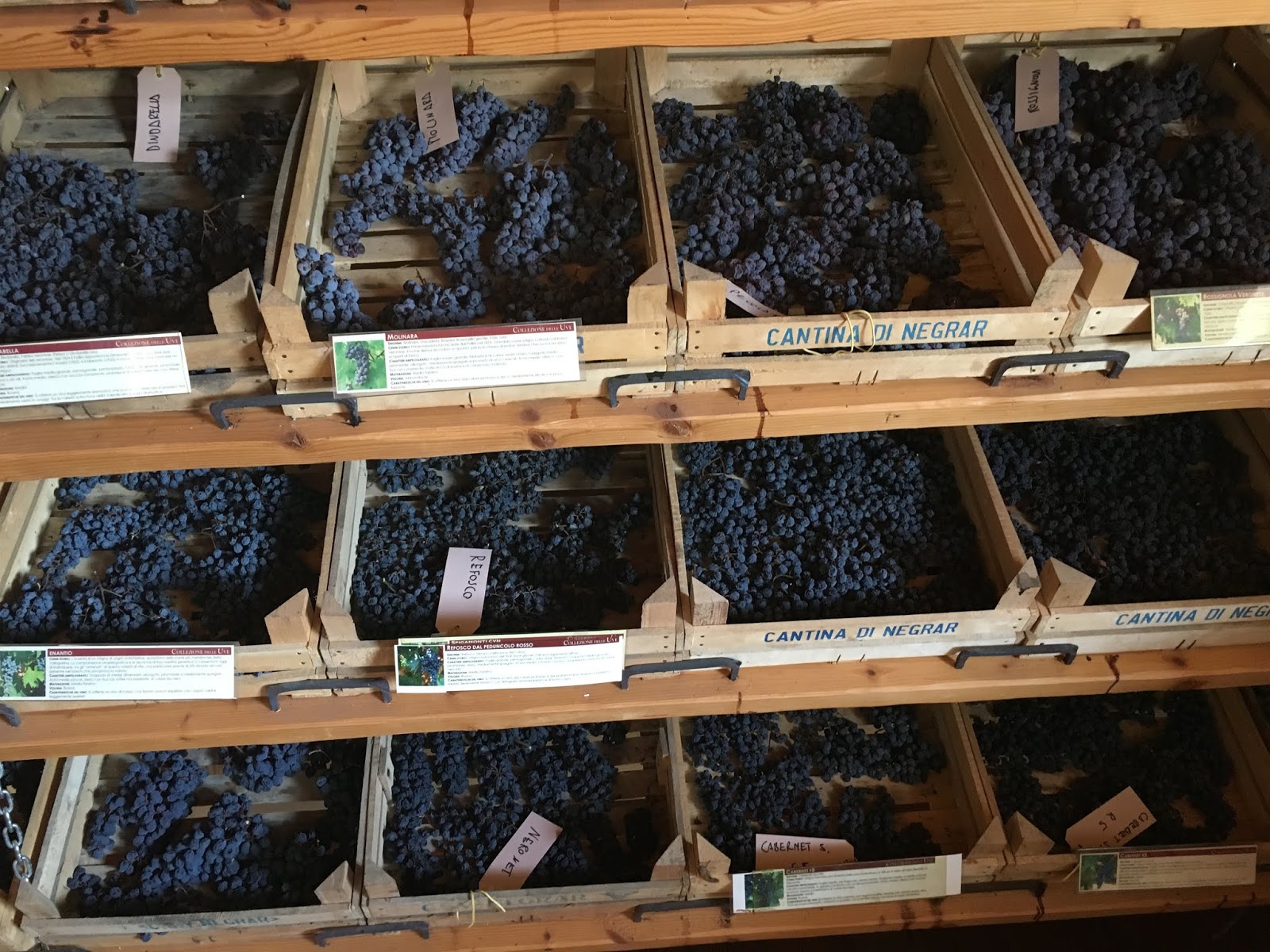
Having visited the region on several occasions, but, never during the harvest, I have learned that the grapes are hand-harvested and laid out on straw mats for a minimum of four months to turn into the prime grape (s) for Amarone della Valpolicella DOCG. Then, the grapes are pressed. Fermentation can last up to two months, thanks to low temperature fermentation.  The wine is then transferred to chestnut or oak barrels to age, following the laws of the region.

As I mentioned earlier, Amarone is scarce. There are only 12,000 acres that satisfy the region for Amarone. That is where the Corvina and Corvinone grapes thrive.

Interviewing several winemakers, the Corvina grape is their favorite varietal. It may be because the other grape they love is Corvinone. Unfortunately, the grape is rare, making Corvina their first choice.

The rule of thumb with Amarone is quite simple.
‘The older, the better.’

At a recent Anteprima Amarone tasting, I sampled a 1950 Amarone that was as fresh and acidic as a wine of that age could be. The true flavor profile of Amarone existed, sixty-eight (68) years later-fig, sweet chocolate and vanilla bean.

Amarone goes through a different process of aging versus other wines. The final palate flavor resonates with me.

Few wines are made the same way-grapes are dried for four months, then the grapes are slowly pressed and then fermented for sixty (60) days.

These are just a few reasons why I believe Valpolicella is like no other wine.

Philip S. Kampe


Monday, July 30, 2018

Valpolicella, The Whole Story by Philip S.Kampe


                              The map of Italy highlighting the Valpolicella region
                   Besides Corvina, Valpolicella is home to many other varietals
                                                          Drying of the grapes

            
Its always uplifting to receive so many emails about my many Valpolicella articles.

Yes, my father gave me my first sip of Valpolicella when I was under ten years old. Yes, my wife, from Italian roots has family members who drink a glass or two of Valpolicella daily. They say it is for health reasons. And, yes, I always try to promote Valpolicella to others at dinners or parties at our house or bring a bottle as a gift to those with or without wine knowledge.

As a true novice Valpolicella wine lover, I am happy to share with you the facts I know about this wine and realize that there are numerous Valpolicella Ambassadors who know so much more then I do and live the life of true devotion to ‘everything Valpolicella.’

Where is Valpolicella’s home:
The province of Verona, east of Lake Garda.

Climate:
Mild to cool Continental climate

Valpolicella styles:
Valpolicella Classico, Valpolicella Superiore, Recioto, Amarone

When did Valpolicella receive DOC status?
1968

Serve Valpolicella:
Slightly chilled

The Valpolicella Story:
Historical documents suggest that in the 5th century, Cassiodorus, minister of Theodoric the Great, suggested to the barbaric king of the Osthrogots that he should try a sweet wine from one of the territories of his kingdom.

The wine he suggested was from near Verona, which was the capital of the Italian territories that Theodoric the Great, his King, ruled.

Cassiodorus went on to explain that the wine comes in both red and white varieties and was made with the Corvina grape, which is left to dry (four months) until winter before being crushed.

Fast forward 1600 years and similar wines from the Valpolicella region are made using the same process and the same, Corvina varietal. The grapes are dried, many for four months, after harvest and turned into the Recioto style of Valpolicella.

The grape drying process is actually quite complex. The process activates more then four-hundred (400) genes that control the metabolism of the grapes, which activates secondary flavors and classic aromas of both Recioto and Amarone. Corvina may be the only grape that remains active and functioning during the drying process. Other grapes remain inactive. While being active when drying, the Corvina grape develops the classic aromatic profile of Amarone.

If the Corvina grapes grow in different appellations throughout the world, the grape would take on different characteristics and would not remain active when drying. That tells us that the perfect conditions for the Corvina varietal exist only in the Valpolicella region. It has been that way, as I illustrated, for thousands of years. This is why Valpolicella wines excite my palate..

Where did the name come from?
The name, Valpolicella, comes from Latin, Vallis Polis Cellas, which translated, means, ‘Valley of the Many Cellars.’

Are there other indigenous grape varieties grown in Valpolicella?
Yes, besides Corvina, many varieties exist. Molinara, Oseletto, Rondinella, Pelara, Garganega and Croatina, to name a few.

What you need to know about Valpolicella DOC:
Valpolicella is made using fresh grapes. Recioto and Amarone are made using dried grapes. The three most popular grapes in the Valpolicella wines include, Corvina (which you should know about), Molinara and Rondinella.

How do I read the labels?
If the label has Valpolicella Classico on it, the wine was produced in the historical wine producing area of Valpolicella. If the label just has Valpolicella, the wine comes from the extended Valpolicella wine producing region. Valpolicella grapes are always picked after the grapes for Recioto and Amarone. The quality may be the same, but, those grapes that are picked first are purposely picked out for their drying potential. Most grapes can’t withstand the four month drying period.

What should you expect when tasting Valpolicella?
Valpolicella is a medium-bodied, crisp, acidic wine with a secondary fruitiness, typical of the Corvina grape, which normally accounts for 70% of the grape blend. Its deep ruby color and soft palate appeal make for a terrific food wine. As I mentioned earlier, chill your bottles for 15-20 minutes before serving.

Are Valpolicella wines expensive?
No, quite the opposite.
Valpolicella wines are inexpensive and very affordable.


Philip S. Kampe


Friday, July 20, 2018

Valpolicella Is A Soft, Fruity Summer Wine by Philip S. Kampe


                                           Valpolicella DOC Celebrates ’50 Years’

During the summer, many of us tend to drink lighter wines-Rose, Prosecco and New Zealand Sauvignon Blancs.

So do I, to a point.

When that point arrives, my psyche tells me, quite loudly, ‘Where is the Valpolicella?’
Maybe its in my DNA-and it could be. In one of my articles I related to my readers that my father, a man with a curious palate, was a big fan of Valpolicella. Nearly every evening he would have a glass of Valpolicella before bedtime. It was his brandy.When company came over and my parents entertained, my father was most proud to open a couple bottles of Valpolicella and discuss the flavors and vintages with their guests. Needless to say, I sampled many vintages during the years and was so pleased to take part in a vertical tasting in Verona, hosted by the Consorzio Tutela Vini Valpolicella/ I’m sure that many of the wines I sampled were the same as my father poured.

2018 is the 50th Anniversary of Valpolicella receiving its Denomiazione di Origine Controllata (DOC) cerification. Did you know that Valpolicella ranks just after Chianti in total Italian DOC production. The reason is that the vinicultural zone of the province of Verona, east of Lake Garda, in Veneto, is an agricultural powerhouse.

The hilly, fertile land is home to endless wine production.

Three grape varieties are the core of Valpolicella:


Molinara, Rondinella and Corvina Veronese. Many wine variations are produced from these grapes. All are my favorites, which include Valpolicella Classico, Valpolicella Superiore, Amarone and a Recioto dessert wine.

The fertile land in Veneto was the home of the ancient Greeks, who coined the name, Valpolicella, in the 12th century, which loosely translated means, ‘Valley of Cellars.’
With over 60 million bottles produced a year and 75% of the bottles exported, Valpocella remains a sought after wine commodity. The three categories of Valpolicella, sales wise, break down to: 45% Ripasso DOC, 32% Valpolicella ROC and 22% Amarone DOCG.

Authenticity has popped up regarding European wines, mostly due to several issues concerning Spanish, French and Italian wines. To address the issue, the Corsorzio Tutela Vini Valpolicella has adopted the Reduce, Respect, Retrench (RRR) certification. The RRR certifies ‘ethical vineyards.’ What that means is that the vineyards receive certification after five years of work practicing sustainable vine growing and wine producing. According to Olga Bussinello, director of the Valpolicella Consorzio, ‘The RRR certification was a necessary change to foster its spread even more and to reward the virtuous viniculturalists who have followed the process in its pilot phase. This is the first certification of an area with an appellation ‘startup’ in Italy, shared and achieved with the support of local towns, partners in the project, which includes 73% of the vineyard surface area in the Valpolicella appellation Certifying an area entails understanding the landscape and that of the ecosystem, from resource management to safeguarding biodiversity, to the protection of a territory where processional viniculture and urbanization are side-by-side-which is just one chapter in the process.’

A territory as outstanding as Valpolicella understands the demands of the western world, where sustainability comes into play.

Why I love Valpolicella: 97% of the grapes used are indigenous varietals. Sustainability is on the radar. There are 2,347 grape growers, 213 wine companies, 7 cooperatives and 275 bottlers.

Plus, it was my fathers favorite wine.

Happy 50th DOC Anniversary Valpolicella.
We Love You…

Philip S. Kampe


Wednesday, July 4, 2018

My Favorite BBQ Wines by Philip S. Kampe


                                               My Favorite BBQ Wines

Well, on the 4th of July, the truly ‘All American’ holiday, its hard not to celebrate what our country has done in the past and ponder the future. Family celebrations, parades and the smell of the BBQ seduces many of us.

If you are a BBQ fan and want to pass on beer with the main course, I have found a couple of ‘American’ wines that do the trick for the main BBQ meat course pairing.
Both wines are under $20 and are made in the USA.

Donald Hess purchased vineyards on Mount Veeder (California) in 1978. Mr. Hess is not American, but, a Swiss entrepreneur. He bottled his wines in 1983 and in 1986 renovated the winery, its biggest renovation since being constructed in 1903 by Colonel Theadore Gier.

The winery was open to the public, tasting room and all, in 1989. It is now part of the Hess Collection of wines, that includes Su’skol and Allomi in Napa Valley and Shirtaol Creek Vineyard in Monterey.

Donald Hess is known worldwide because of his wine philosophy. ‘Nurture the land, return what you take.’

The two wines that work well with BBQ are the Hess Select Central Coast 2016 Pinot Noir and the Hess Select North Coast Cabernet Sauvignon.

Both wines deliver the essential acidity, spice and fruitiness that is needed when you eat BBQ.

Hesss Select is distributed nationwide and should be at your wine merchants shop or online.

These two wines are what I usually bring to a BBQ.

I don’t grill, so, feel free to invite me over to share your BBQ and I will bring the wine.

Philip S. Kampe


40 Years of Winemaking at Russian River Valleys Sonoma-Cutrer by Philip S. Kampe

 Innovation in Winemaking at Sonoma-Cutrer began forty years ago. The focus has always been innovation for this Russian River Valley winery....